ALEC & Your Communications: Part 1: How AT&T, ALEC and the Other Communications Companies Created Model State Legislation to Harm You

  • Part 1: AT&T et al and ALEC created state-based model communications legislation which was used in many states to remove regulation and oversight.
  • Part 2: ALEC state-based laws end up as principles in AT&T’s petition to the FCC to close down America’s utility networks.

NRRI Report, May 2013

“Twenty-five states had passed legislation eliminating or reducing state commission authority over telecommunications by the end of the 2012 legislative sessions. By the end of 2013, this number could increase significantly, given the legislation pending in states across the country. Legislation reducing regulatory oversight (or clarifying the deregulation initiatives passed earlier) was proposed in 20 states during the 2013 legislative session… Should the majority of the legislation pending in the 2013 sessions be enacted, nearly 70% of the states will have significantly reduced or eliminated commission jurisdiction over retail telecommunications services.”


Let’s connect the dots.

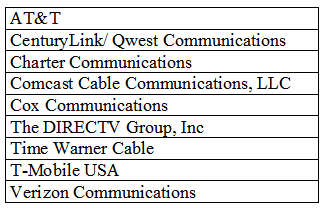
Starting in 2007, AT&T, Verizon, Centurylink and the cable companies, working with a group called the American Legislative Exchange Council (ALEC), created state-based model legislation and principles designed by the companies to accomplish one thing — the removal of all regulations, obligations and oversight on the companies’ businesses. As the NRRI report outlines, 25 states have removed some, if not all regulations and oversight, and there are more to come in 2013.

ALEC Communications & Information Technology Members
2013-05-16-alectelecomlarger.png
The ALEC corporate communications cabal includes the three largest incumbent wireline phone companies, AT&T, Verizon, Centurylink, as well as three of the largest wireless companies, AT&T, Verizon and T-Mobile, and three of the largest cable companies, Time Warner, Comcast and COX.

We note that Sprint/Nextel left ALEC in 2012.

Read More


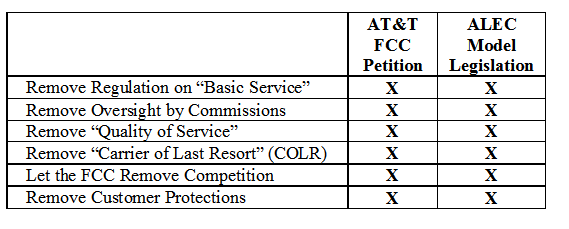
AT&T, ALEC, FCC, Part 2: The AT&T FCC Petition is ALEC Model Legislation.

Connect the Dots: AT&T Petition and ALEC State Model Legislation
2013-05-22-ATTALECFCC.png
In the previous post we examined the state-based ALEC model legislation that was created by AT&T et al and how it was used in some states, including Florida.

However, the ALEC model legislation was created by AT&T; the fact that AT&T filed a petition with the FCC to finish the ALEC state-based campaign at the federal level should come as no surprise.

Brief History

In December 2009, AT&T filed comments with the FCC as part of National Broadband Plan titled “The Transition from the Legacy Circuit-Switched Network to Broadband” which laid out, in detail, the AT&T-ALEC model of the future — remove as much regulations and obligations as possible.

In 2009, AT&T et al got the FCC to create a group within the FCC’s Technological Advisory Council (TAC) to start the process of “sunsetting” — i.e., closing down America’s utility networks — the Public Switched Telephone Networks (PSTN). As we discussed, TAC is as model of regulatory capture. AT&T and Verizon, (two of the largest incumbent phone companies who control the PSTN in their states) are not only on the committee but the majority of the TAC members have direct financial ties to either AT&T or Verizon or both.

Moreover, the TAC has been headed by Tom Wheeler, who is the Obama nominee for the new chairman of the FCC, replacing Julius Genachowski — and was former head of the cable association, the NCTA, and the wireless association, CTIA.

In August 2012, AT&T set the stage with a letter to FCC Commissioner Ajit Pai, outlining the ALEC principles.

Read More

Regulatory Capture of the FCC – Time to Clean House

AT&T, with the help of Verizon and the cable companies have ‘captured’ the FCC — and have been able to get the federal agency to create and shape a working group designed specifically to remove all regulations and obligations, close down the Public Switched Telephone Networks (PSTN) and create new digital dead zones.

Think of this as — Imagine taking a company to court and you find out that the judge, most of the jury, and even your lawyer has a direct financial tie to the company you are suing… Think you’ll win?

Moreover, AT&T’s FCC play is part of a massive, well choreographed, multi-year state and federal campaign being orchestrated with ALEC, the American Legislative Exchange Council, to remove all regulations and obligations and harm America’s communications users — i.e., you, dear reader…

With the Wall Street Journal reporting a changing of the guard at the FCC, with FCC Chairman Julius Genachowski and the Republican Commissioner Robert McDowell leaving in the next few months, we need new people who are going to fix, expose and stand up to the corporations, not kowtow to them.

Regulatory Capture & Financial Conflicts of Interest vs Open Government.

Read more

Tom Wheeler Should Not Be the Next FCC Chairman: Do You Like Your Wireless Bills?

Sen. Jay Rockefeller (D-W.Va.) on Tom Wheeler: “A lobbyist is a lobbyist.”

“Tom Wheeler, Former Lobbyist and Obama Loyalist…” April 16, 2013 | TIME Magazine

The FCC oversees and makes regulations for most communications in America today, including our wireline, wireless, broadband, Internet, cable, and satellite services, not to mention the media you see.

Thomas E. Wheeler is the heir apparent to the departing FCC Chairman Julius Genachowski.

Do You Like Your Wireless Charges?

From 1992 through 2004 — 12 years — Tom Wheeler was president and CEO of the Cellular Telecom and Internet Association — commonly known as “CTIA, the Wireless Association.”

This brings up the issue — what did he do for your wireless services today that started during these 14 years and what will he do if he becomes the new FCC chairman?

The CTIA works for its clients, AT&T Wireless, Verizon Wireless and the other wireless companies; their position was Wheeler’s position during his 14-year tenure. The wireless companies fought to keep phone bills unreadable, add dubious made-up charges on your bills, and even lobbied to not be held accountable if their customer representative misleads you, among other items. From excessive early termination fees to not being able to take the companies to court if they harm you, Tom Wheeler’s CTIA is on record with filings at the FCC to protect the interests of the wireless companies — not your interests.

If Wheeler is nominated to be FCC chairman he would have to take on his previous clients, but the likelihood of this is that you have a better chance of winning the lottery — twice.

Today, there are lots of problems with wireless services. The FCC claims that one in six have been hit with “Phone Bill Shock.”
Read More